



7 June 2026
Ethical uniform supply chains – why should care homes care?
When you manage uniform procurement for a large care home group, the decisions you make extend well beyond fabric choices and colour palettes. Behind every garment is a supply chain, a network of raw material producers, textile mills, manufacturers, and logistics providers. And the ethics of that supply chain are increasingly under scrutiny from regulators, commissioners, and the families of the people in your care.
The care sector operates on trust. Residents and their families trust you to deliver safe, dignified care. Commissioners and local authorities trust you to run a responsible operation. Choosing care home uniforms from a supplier whose practices are opaque, exploitative, or environmentally damaging undermines that trust, even if the garments themselves look and feel fine.
Why ethical supply chains matter in care home procurement
Care homes exist to look after vulnerable people. That mission does not stop at the front door. If the uniforms your staff wear are produced in factories with poor labour conditions, or manufactured using processes that cause significant environmental harm, there is a disconnect between the values your organisation promotes and the purchasing decisions it makes.
The textile industry is one of the most labour-intensive and environmentally impactful sectors in the world. Garment supply chains are complex and often span multiple countries, making them particularly susceptible to exploitation, forced labour, and environmental malpractice. For care home groups procuring thousands of garments across dozens of sites, the cumulative impact of those purchasing decisions is significant.
Ethical procurement is also a growing regulatory expectation. The Modern Slavery Act 2015 requires organisations with a turnover above £36 million to publish an annual modern slavery statement. The Social Value Act shapes how public sector contracts are evaluated. And the Care Quality Commission’s well-led framework increasingly considers how providers manage their wider responsibilities, including supply chain governance. If your organisation is commissioning care on behalf of local authorities or the NHS, demonstrating ethical procurement practices is expected.
The risks of an opaque uniform supply chain
Understanding the specific risks helps you ask the right questions of your current or prospective uniform supplier. Here are the three areas where care home groups are most exposed:
What an ethical uniform supply chain looks like
Ethical and sustainable uniforms are the result of deliberate choices made at every stage of the uniform lifecycle, from raw material sourcing through to end-of-life disposal. Here is what you should expect:
Traceable raw materials
An ethical uniform supplier should be able to tell you where the raw materials in your garments come from. For cotton, look for sourcing through the Better Cotton Initiative (BCI) or equivalent standards. For polyester, ask whether it is recycled and certified under the Global Recycled Standard (GRS). Traceability is the foundation of an ethical supply chain. Without it, no other claim can be verified.
Fair and safe manufacturing
The factories that produce your care home uniforms should operate under fair labour conditions, with living wages, safe working environments, and no use of forced or child labour. Reputable suppliers own or directly manage their manufacturing facilities, which gives them far greater control and visibility than those who subcontract to anonymous third-party factories.
Responsible environmental practices
Eco friendly uniforms are made using processes that actively minimise environmental harm. This includes reducing water consumption and chemical use in dyeing, lowering carbon emissions during manufacturing and logistics, and using energy from renewable sources where possible. A credible supplier will hold certifications and publish data to support these claims.
End-of-life planning
The uniform lifecycle does not end when a garment is retired. Sustainable workwear programmes should include a plan for what happens to garments that are no longer fit for use. This might involve repair schemes to extend garment life, rework programmes that repurpose materials, or closed-loop recycling systems that recover fibres for reuse. A supplier that takes responsibility for the full lifecycle of its products is demonstrating a genuine commitment to sustainability. Our ARX initiative helps ensure garments are responsibly reused, repurposed or recycled at the end of their working life.
Why this is more important for care homes than you might think
You might assume that ethical supply chain scrutiny is primarily a concern for NHS trusts or public sector bodies, and that independent care homes are under less pressure. However, the opposite is increasingly true.
Commissioner expectations are rising
Local authorities and integrated care systems are placing greater emphasis on social value when awarding and reviewing care contracts. How you procure (not just what you procure) is becoming part of the evaluation. Care home groups that can demonstrate ethical, sustainable procurement practices are better positioned when contracts are reviewed or re-tendered.
Family and resident expectations are changing
Sustainability is no longer a niche concern. Families choosing a care home for a loved one are increasingly attentive to the values an organisation demonstrates, from its approach to staffing and wellbeing through to its environmental footprint. Sustainable uniforms are a visible, tangible signal that your organisation takes its responsibilities seriously.
Staff recruitment and retention
Care workers, particularly younger staff entering the sector, are more likely to want to work for organisations whose values align with their own. Demonstrating that your uniforms are responsibly sourced and sustainably made is a small but meaningful part of presenting your organisation as one that cares about more than the bottom line.
Questions to ask your uniform supplier
If you are reviewing your current uniform arrangements or approaching a new procurement cycle, these are the questions that will help you assess whether your supplier’s supply chain meets the ethical standards your organisation requires:
A supplier that owns its manufacturing operations will have far greater visibility than one that outsources to unnamed subcontractors. Full traceability is the first indicator of a supply chain that can be genuinely audited and verified.
1. What certifications do you hold?
Look for Global Recycled Standard (GRS) certification, Better Cotton Initiative membership, and credible third-party audits of labour practices. Certifications are not perfect, but they provide a baseline of independent verification that self-reported claims cannot.
2. Do you publish a modern slavery statement?
Even if your supplier falls below the £36 million turnover threshold, a voluntary modern slavery statement signals that they take labour ethics seriously. Review the statement for specifics: does it describe concrete actions and due diligence processes, or is it generic boilerplate?
3. What happens to garments at end of life?
Ask whether your supplier offers repair, rework, reuse or recycling programmes. Suppliers that can demonstrate a clear end-of-life strategy are better positioned to help organisations support their wider sustainability objectives.
4. What are your carbon reduction commitments?
A credible supplier will have a published Carbon Reduction Plan with measurable targets, not vague aspirations.
Learning from the NHS approach
The NHS Supply Chain has led the way in embedding ethical and sustainability requirements into uniform procurement. The NHS Healthcare Uniform Framework requires suppliers to meet stringent criteria around carbon reduction, modern slavery due diligence, social value, and the Evergreen Sustainable Supplier Assessment. NHS Healthcare Uniforms are made with 100% recycled polyester and Better Cotton Initiative cotton, and suppliers are assessed against a structured net zero roadmap.
Care home groups do not have an equivalent centralised framework, but that does not mean the standards are irrelevant. The NHS approach provides a useful benchmark for what good ethical procurement looks like. If your uniform supplier already meets the NHS framework requirements, you can be confident that their supply chain has been subject to rigorous scrutiny.
How alsico supports ethical and sustainable uniform procurement for care homes
As one of Europe’s largest uniform manufacturers and a leading care home uniform supplier, alsico operates a fully traceable, vertically integrated supply chain. We own and manage 21 factories across 11 countries, which means we have direct oversight of every stage of production — from raw material sourcing to finished garment delivery. We do not subcontract to anonymous third-party factories.
- GRS-certified manufacturing using 100% recycled polyester and sustainably sourced cotton.
- Full supply chain traceability across our owned global factory network.
- Published Carbon Reduction Plan aligned to the NHS net zero supplier roadmap.
- Circular textile solutions through our arx initiative (care, repair, rework) and 3CL closed-loop recycling project.
- Member of Care England, the largest representative body for independent adult social care providers.
- Trusted by national care home groups including Aria Care Group, with 50 homes across England, Scotland, and Jersey.
Our sustainability commitments are built into how we operate. When you partner with alsico, you gain a uniform supplier whose ethical credentials have been tested at the highest level, including the NHS Healthcare Uniform Framework, and applied to care home groups of every size across the UK.
Explore how we have worked with other care organisations through our case studies.
If you are reviewing your care home group’s uniform supply chain or looking for a supplier whose ethical credentials match your organisation’s values, our team can help.
healthcare environments we provide uniforms for
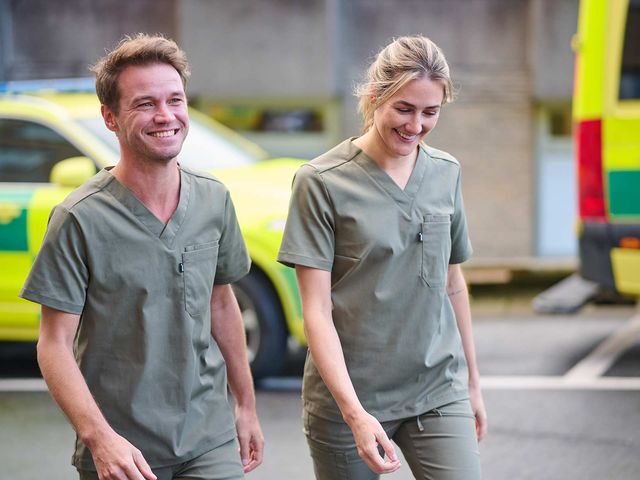
healthcare providers
Mobility, total hygiene and comfort. The high demands of an operating theatre are reflected one by one in our clean-air healthcare tunics and healthcare trousers.

healthcare science
From support areas to research labs, our healthcare garments uphold the highest standards, ensuring consistency and excellence throughout your healthcare sciences.

support services
Ensuring your entire operation is clothed in the very best, our workwear solutions for non-clinical areas ensure a consistent and high-quality result for your business.

business administration
Our range embodies a perfect blend of style and durability and meets the needs of the workplace environment. Experience the transformation our office wear solutions can bring to your role.

food services
Food preparation in a healthcare environment demands superior quality, high durability, and comfort for long shifts in the kitchens.

contamination control
When the height of safety is required, our healthcare garments for high-demand areas are made to perform.
get in touch
